

Remote Air Piloted vs. Direct Solenoid Valves: Engineering Tradeoffs
For today’s PC- and PLC-controlled automation equipment, solenoid valves are often the first choice for media control. However, remote air piloted valves are frequently overlooked as a viable, cost-effective, reliable and sometimes more compatible solution.
The choice between control valve types comes down to the functions a valve needs to perform, and how that shapes system performance, cost and reliability.
Air piloted valves are typically controlled by remotely positioned solenoid valves: smaller solenoid and manual piloting valves mounted away from the point of use. Most directional control pneumatic solenoid valves, particularly four-way designs, are actually air piloted valves controlled by an onboard miniature solenoid valve.
Understanding the relationship between direct solenoid and remotely air piloted actuation can help you choose the right approach for your application.
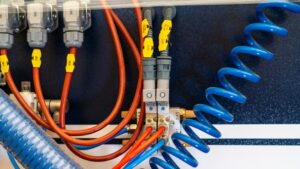
Valve Actuation Methods
Solenoid valves: This type of valve uses electrical actuation to create a magnetic field that moves a plunger or armature to open or close the port.
Pneumatic controlled or air piloted valves: Rather than electrical current, pneumatic controlled valves are remotely air-operated and shift based on the output signal of another valve. These valves rely on simple construction and few parts to deliver high shifting force and tight sealing. Many higher-flow solenoid valves work the same way internally: a small direct-acting solenoid pilots a larger diaphragm-poppet or piston-poppet valve rather than shifting the flow path itself.
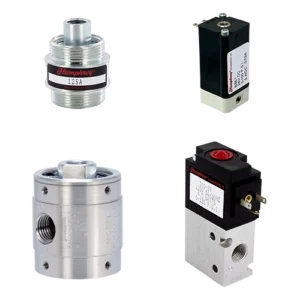
Control Accuracy and Response Features
Response time, precision and repeatability differ between the two valve options, and selecting the better-suited valve often depends on the environment as much as the product specs.
Solenoid valves:
- Move quickly upon actuation
- Support precision control over media flow
- Integrate with sensors, the Internet of Things and remote operation
Those factors make them a strong fit for repeat cycling in a broader control system.
Air piloted valves:
- Feature simple construction
- Offer high shifting force and tight sealing
- Resist sticking or leaking
Operating environment is one of the clearest differentiating factors. Air piloted valves are reliable in hazardous and dirty environments, making them the better choice wherever contamination and wear resistance pose problems.
Solenoid valves tend to function better in clean, high-cycle environments where speed and PLC integration are the priority and electrical actuation isn’t a hazard.
Key Features and Applications
Solenoid valves stand out for compact size, fast on/off switching, simplicity and low maintenance.
Humphrey’s air solenoid valve line spans direct-acting and pilot-operated designs. Our products can provide you with reliable compressed air control in applications that call for a compact, balanced-poppet direct-acting valve or a pilot-operated design built for higher flow.
Air piloted valves are suited for modulating control, simultaneous functions, hazardous environments and heavy-duty industrial use. Humphrey’s Diaphragm-Poppet Air Piloted Valves are built without sliding seals to avoid sticking or wearing. That allows them to serve synchronized functions, interlock with other valves and handle alternative media.
Both valves show up across a range of applications, including:
- Process control: Solenoid valves can handle dispensing, isolation, sequencing and pressure regulation, while air piloted valves work as slave and lockout valves in coordinated processes.
- Packaging and high-speed automation: Solenoid valves control pneumatic actuators and cylinders on assembly lines and in pick-and-place robotics, where PLC-integrated switching requires tight cycling.
- Hazardous locations: Air piloted valves are the safer choice wherever electricity poses a risk, and they hold up well in dirty or poor air conditions.
- High-flow requirements: Air piloted valves are an effective alternative when a solenoid valve covers most of an application’s flow needs, but specific points demand higher volume.
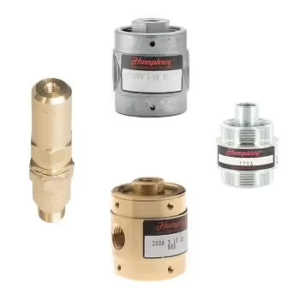

Choosing Between a Pneumatic Control Valve and a Solenoid Valve
Environment: If your application is hazardous, dirty or otherwise a poor fit for electrical actuation, air piloted valves are the more reliable option.
Control precision: If your system requires fast, precise on/off switching integrated with sensors or a PLC, a solenoid valve is the better fit.
Power availability: Air piloted valves don’t rely on electrical current at the point of actuation, which matters when power access isn’t readily available.
Duty cycle and cost: Remote piloting is more cost-effective and consumes less compressed air than actuating a larger valve directly with a solenoid.
Depending on the specifics of your equipment, you may be able to use both valve types, boosting cost savings, performance reliability and operator safety. A direct-acting solenoid valve piloting a larger diaphragm-poppet or piston-poppet air piloted valve combines the strengths of solenoid actuation with the cost savings and high shifting force of air piloted operation.
Choosing the Right Valve Is Just the First Step
Working through actuation method, response requirements, environment and cost is a strong start. But getting the details right for your specific system through design support, testing and standards compliance requires an extra set of expert eyes.
If you need help choosing the right pneumatic control or solenoid valve for your application, or have questions about our products, contact us or call 1-800-477-8707.