

Pneumatic Automated Systems and Directional Control Valves
Directional control valves (DCV) are a primary component in pneumatic automation systems. They control the flow path of compressed air media.
While the basic functions of 3-way, 4-way, and 3-position 4-way valves have remained largely unchanged, the evolution of how they’re packaged and controlled has. For example, today, multiple valve manifold “islands” can be controlled by sophisticated Fieldbus networks. And some 3-position 4-way types are now adjustable with actuation methods that allow for proportional control.
While electronically controlled actuators continue to grow in popularity, DCVs maintain their place as a reliable industry standard. As automation systems continue to evolve, those components can provide the design needed to withstand rugged environments.
Learn how DCVs are changing alongside automated equipment.
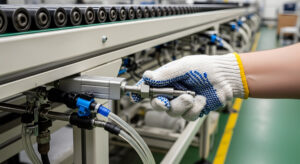
How Directional Control Valves Support Automated Systems
DCVs regulate and exhaust compressed air to cylinders, actuators and other devices in pneumatic automation systems. They control components that clamp, press, move, turn and process workpieces in industrial automation equipment.
Compressed air can be extremely dangerous if not controlled properly during use. Because DCVs regulate the compressed air, they can also stop media movement as a failsafe if there’s a malfunction to prevent that energy from being misdirected.
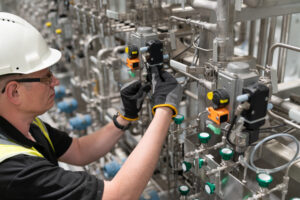
Types of Directional Control Valves
These valves consist of a supply port, one or two outlet ports and one or two exhaust ports that function as 3- or 4-way pneumatic configurations. With the advent of PLC- and PC-controlled systems, the most common method of switching DCVs is with a solenoid operator. Air pilot operators are less common but have value as slave valves and in hazardous environments.
Valve types include:
- 3-way valves: This DCV controls single-acting, spring-return pneumatic cylinders, vacuum generators and other process-related valves. A 3-way DCV has three ports: inlet, outlet and exhaust.
- 4-way valves: A 4-way valve predominantly handles double-acting pneumatic air cylinders. The 4-way design has an inlet, two outlets and two exhaust ports.
- 3-position, 4-way valves: A 3-position 4-way valve handles double-acting pneumatic air cylinders. It includes an inlet, two outlets, two exhaust ports and two operators. A third neutral position occurs when neither operator is actuated, offering additional control opportunities for the air cylinder.
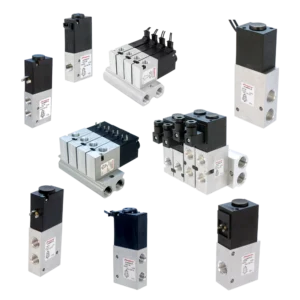
Humphrey Products Directional Control Valves
Our Balanced Solenoid Valve Series of direct-acting, multi-purpose 3- and 4-way types is designed for equipment makers seeking cost-effective, versatile and reliable performance.
Features:
- Three sizes: 15mm, 19mm and 25mm
- Two position: 3- and 4-way configurations
- Reliable through full pressure range: Vacuum to 125 PSI
- Flow capacity models range from 0.16 to 1.20 Cv
- Multi-purpose with unlimited piping options for each valve
- Inline and manifolding types
- Water and dust ingress protection
How to Choose the Right Directional Control Valve for Your Application
- Define your application requirements: The operating pressure, flow rate and actuator size will influence the minimum required valve size. The media and ambient environment extremes (temperature and cleanliness) will determine the seal and necessary protection measures.
- Determine whether 3-way or 4-way is required: The downstream component being controlled will have one or two ports. If it’s a single port, a 3-way function is required. If two, then a 4-way function is needed.
- Select actuation method: Actuation will determine how your valve shifts from one position to another. Options include solenoid, pilot-operated and mechanical activation.
- Assess required flow capacity: Selecting the wrong valve can result in sluggish motion or overconsumption that leads to inefficiency. You must calculate the required flow rate to determine whether a valve can deliver adequate flow at your system’s available pressure differential.
Directional Control Valves from Humphrey Products
Choosing the best directional control valve solution to optimize your automation equipment can get complicated. You can rely on the experts at Humphrey Products to assess your requirements. We’ll evaluate the details and challenges to provide a personalized product recommendation. We also offer technical support to ensure your valve operates properly after installation. Contact us for assistance.